
The Car That Defined the Modern Supercar
Lamborghini Miura history: The supercar that changed everything.
The Lamborghini Miura is widely regarded as the world's first true supercar and is credited with redefining the high-performance road car.
Introduced in 1966, the Miura brought together a mid-mounted V12 engine, dramatic Bertone design, and road-going usability in a way that helped set the template for the modern supercar: exotic layout, radical proportion, extreme performance, and a sense of theater that began before the engine even started.
For enthusiasts exploring Lamborghini heritage, the Miura remains a clear expression of early Lamborghini: V12 power, Italian design, and radical engineering. Discover this history at an indiGO Auto Group Lamborghini showroom.
A timeline of the Lamborghini Miura history.
.png)
Before the Miura
Automobili Lamborghini was founded in 1963, and its early road cars, including the 350 GT, established the marque as a serious Italian grand touring manufacturer. These cars were powerful, elegant, and refined, but the Miura pushed Lamborghini into a more dramatic category.
The idea began with a chassis. At the 1965 Turin Motor Show, Lamborghini displayed a bare rolling chassis with a V12 mounted transversely, meaning sideways, behind the cabin. The layout drew attention before the body existed. It looked closer to a racing prototype than a traditional grand tourer.
That chassis became the foundation for the Lamborghini Miura.
1966: The Miura Debuts in Geneva
The Lamborghini Miura P400 debuted at the 1966 Geneva Motor Show. The name came from a legendary breeder of Spanish fighting bulls from Seville, Don Eduardo Miura Fernández, establishing the bull-inspired identity that would become central to Lamborghini.
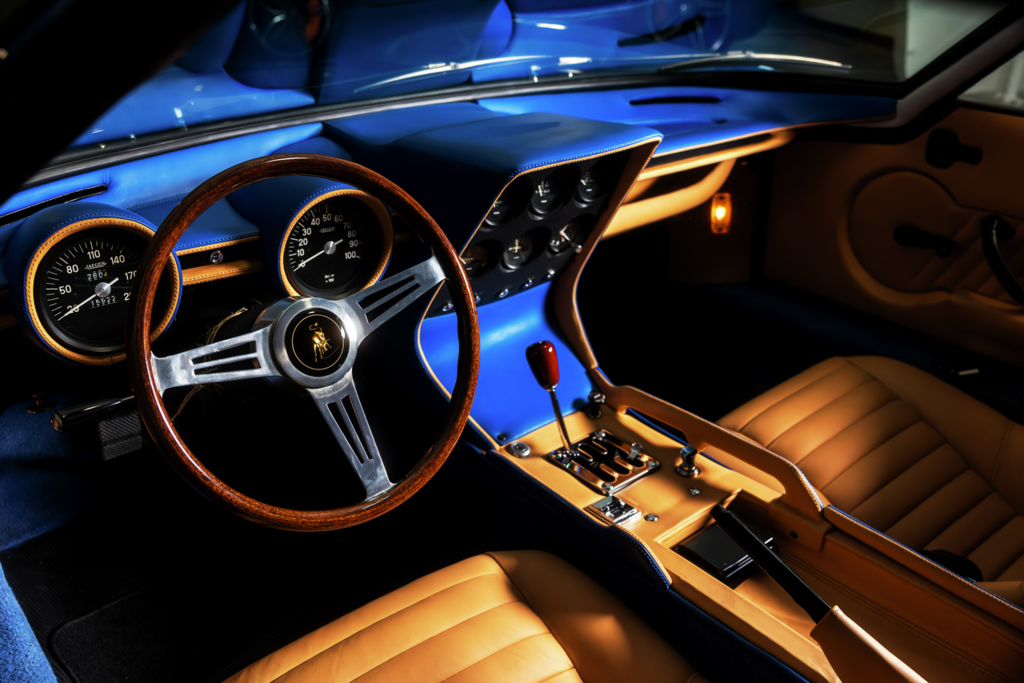
The design was completed with Carrozzeria Bertone, the Italian design house, where Marcello Gandini was serving as Head of Design. The result was low, wide, and unmistakable. The Miura’s headlights, flowing roofline, sculpted side intakes, and rear haunches made the car look unlike the grand tourers that came before it.
Its mechanical layout was just as important. The Miura placed a 3.9-liter V12 behind the driver in a transverse position. Lamborghini lists the Miura debut with a top speed of 280 km/h and 0-100 km/h acceleration in 6.7 seconds, figures that helped establish its performance reputation.
You may also like the: Lamborghini Fenomeno
Why the Lamborghini Miura Was Different
The Miura is widely credited with defining the modern supercar because it combined elements that would shape the category for decades:
- A mid-engine layout
- A dramatic two-seat body
- V12 performance
- Racing-inspired engineering
- Road-car usability
- Design that became part of the car’s impact
Before the Miura, many high-performance cars followed the front-engine grand touring formula. The Miura moved the engine behind the cabin and made that layout usable and desirable on the road.
That shift influenced not only Lamborghini, but the broader supercar world. The Miura helped establish the idea that the most extreme road cars could be mid-engine, visually theatrical, and engineered as much for emotion as for speed. Discover Miura's influence on modern Lamborghinis below.
.png)
The Miura Evolves: P400, P400 S, and SV
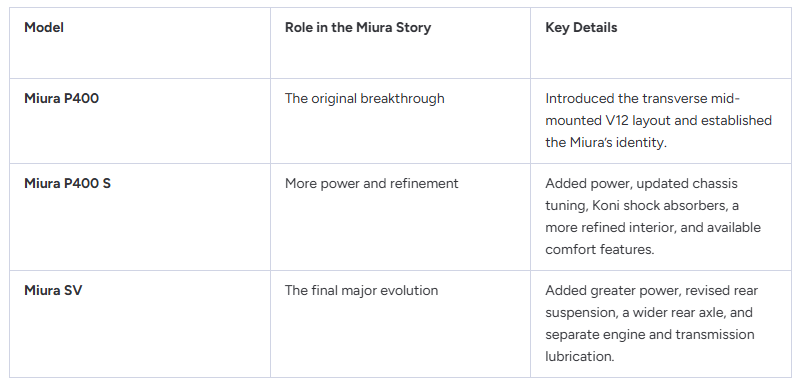
The Lamborghini Miura story is best understood as a progression: the original shock, the refined version, and the final form.
A fun read: Luka Doncic's Car Collection
The P400 was the first production version. Its name referenced the car’s rear-mounted four-liter class V12 layout, with “P” commonly understood as posteriore, Italian for rear, and “400” referring to the engine’s displacement class.
The P400 S arrived in 1968 with more power and refinement. Lamborghini notes the P400 S used a 3.9-liter V12 rated at 370 hp. It added refinement without softening the car’s essential character.
The Lamborghini Miura SV arrived in 1971 as the final major production evolution. SV stands for Super Veloce, or super fast. Lamborghini lists the Miura SV with a 3.9-liter V12 rated at 385 hp, a top speed of over 290 km/h, and 0-100 km/h acceleration in 5.5 seconds. Its separate engine and transmission lubrication helped improve mechanical control by allowing the engine and gearbox to use separate oil systems. Produced from 1971 to 1973, the SV remains one of the most sought-after expressions of the Miura. Experience its legendary heritage below.
.png)
The Lamborghini Miura’s lasting influence.
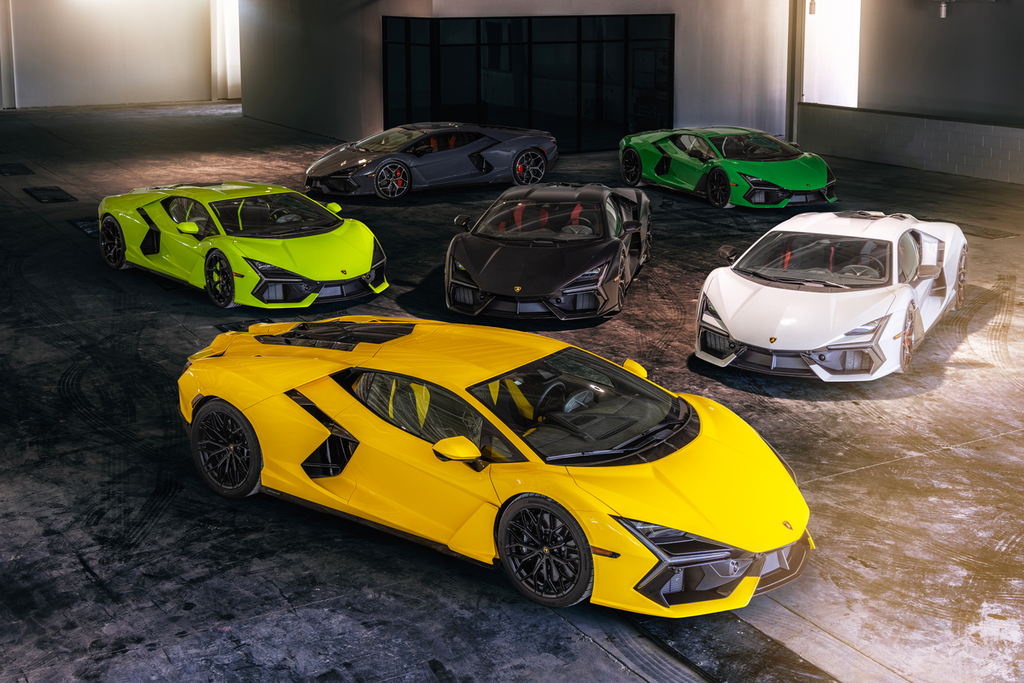
The Miura's influence can still be felt in modern Lamborghini design and engineering. The Countach, Diablo, Murcielago, Aventador, and Revuelto all belong to a lineage that the Miura helped begin. More importantly, the Miura gave Lamborghini an enduring identity: mid-engine drama, V12 theater, radical proportion, and a refusal to follow the grand touring rulebook.
Modern Lamborghini models are far more advanced than the Miura, but the connection is unmistakable. Every modern Lamborghini super sports car carries some part of the Miura’s original challenge: build something bold enough to change expectations.
Explore Lamborghini heritage at indiGO Auto Group.
The Miura mattered because it made the supercar idea real. It combined speed, proportion, sound, engineering, and rarity in a form that felt new for its era. Although it's no longer in production, its influence is still alive in every modern Lamborghini super sports car.
Visit an indiGO Auto Group Lamborghini dealer to explore current Lamborghini models, learn more about the brand’s V12 heritage, and experience how Lamborghini continues to carry the Miura’s spirit into the future.
Recent Posts

Categories:
Take a look at our latest New Inventory
View New Inventory.png)


